Check Engine Light On? Here's What It Could Mean

Demystifying The Feared Dashboard Engine Icon
Few vehicle alerts create as much customer anxiety as the glowing amber check engine symbol (MIL - Malfunction Indicator Lamp). But what does it actually signify, and how urgent is it?
Steady vs. Flashing: Know The Difference
Scenario A: Solid / Steady Amber Light
A solid light indicates that the engine control module (ECM) has logged an emissions-related fault or sensor reading outside normal factory thresholds over two consecutive drive cycles.
- Urgency: Moderate. You can safely finish your commute, but you should schedule a diagnostic inspection within a few days to prevent secondary damage.
Scenario B: Rapidly Flashing Amber Light
A flashing check engine light indicates a catastrophic, active cylinder misfire. Unburned fuel is dumping directly into the exhaust manifold where it ignites inside your catalytic converter, heating the catalyst honeycombs to over 1,800°F.
- Urgency: Extreme. Pull over immediately to a safe location, turn off the ignition, and arrange for a tow. Driving with a flashing check engine light can turn a $150 ignition coil repair into a $2,500 catalytic converter replacement.
The Most Common Diagnostic Trouble Codes (DTCs)
- P0420 / P0430 (Catalyst System Efficiency Below Threshold): Often triggered not by a bad converter itself, but by upstream exhaust manifold leaks, failing oxygen sensors, or cylinder oil burning.
- P0171 / P0174 (System Too Lean - Bank 1 / Bank 2): Excessive air or inadequate fuel. Commonly caused by a cracked rubber PCV intake hose, mass airflow (MAF) sensor grime, or weak fuel pump.
- P0300 - P0308 (Cylinder Misfire Detected): Worn spark plugs, failing coil-on-plug packs, or gummed-up direct injection fuel injectors.
- P0440 / P0455 (Evaporative Emission System Leak): Sometimes as simple as a loose gas cap, but often an EVAP purge solenoid stuck open or cracked charcoal canister vent valve.
Why "Free Code Scans" Fall Short
Auto parts retailers frequently advertise free code scans. While convenient, an OBD2 code is merely an address, not a diagnosis.
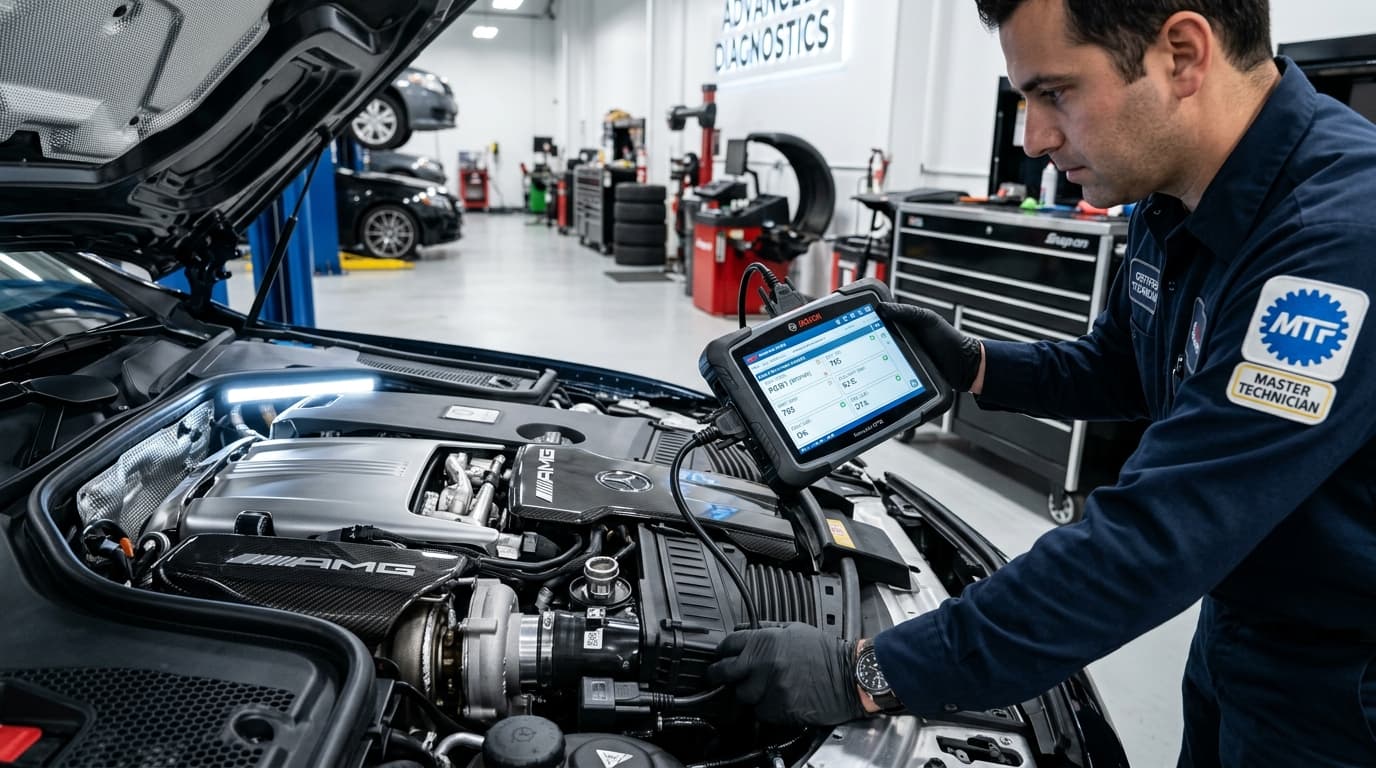
For example, a P0171 code tells you the engine is running lean, but it cannot tell you if the root cause is a faulty MAF sensor, a vacuum hose tear, or low fuel rail pressure. Our certified technicians hook up digital oscilloscopes to sample live sensor wave patterns and smoke-test the intake manifold to verify the exact failure before any part is purchased.
Kenjiro Tanaka
Lead Diagnostic Specialist
Serving the Austin automotive community with advanced diagnostics, honest advice, and master-level craftsmanship.
Concerned About Your Vehicle's Safety?
Don't wait for a breakdown. Book our 45-Point Digital Vehicle Inspection today.
Schedule An Inspection Now